
randomosity

strikingly random thoughts and 'maximum data existentialisation'

  • Research
    • Conference Papers
    • Datasets
      • 1871 Populations of Ontario
      • Breweries and Distilleries in Ontario, 1914–15
      • Canadian Federal Railway Charters
      • 1871 Tavernkeepers in Huron County
    • Maps
      • 1891 Ontario Census Divisions
      • Admissions from Gaols to Hamilton Asylum
      • Asylums in New Zealand, 1900
      • Asylums in Scotland, 1797–1897
      • Asylums in the Australian Colonies, 1860
      • Asylums in Western Canada, 1911
      • Asylums of England and Wales, 1765–1845
      • Asylums of England and Wales, 1845–1860
      • Asylums of Ireland, 1814–1869
      • Discharge Rate from Hamilton Asylum
      • Duration of Stay for First Admissions to Hamilton Asylum
      • First Admissions to Hamilton Asylum by County
      • Rate of Readmission to Hamilton Asylum
      • Study Context
      • 1841 Settlers Map of Ontario
      • 1851 Essex County by Religion Stated in Census
      • 1848 Circulation Map of Paris
      • Modern Circulation Map of Paris
      • Irish and Indian-Trained Psychiatrists in Canada
      • Asylums in the United States, 1850
    • Other Research Stuff
      • Sir Frank Smith
    • Visual Support Materials
      • 1851 — 1911 Essex County Census District Evolution
      • Guelph Historical GIS
      • Occupational Comparison 1867–2007
      • Pajek Apple Taxonomy
      • Napoleonic Timeline
      • 1878 Guelph Mass Model
  • Gallery
  • Archives
  • About
    • Contact Me
    • Contact Me
    • Curriculum Vitae
    • Ligit Results
    • Movies
    • Stuff
    • Stats
    • Collophon
    • Delicious Tags

R Recipes: A Cookbook For Data Analysis and Visualisation

Posted by shawnday on 19 April 2011
Posted in: Info Architecture, Visualization. Tagged: Data Analysis, O'Reilly, Review, Statistics. Leave a Comment

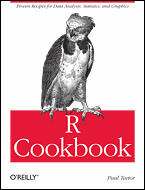
rCookbook.gif The R Cook­book by Paul Tee­tor is a solid addi­tion to the well respec­ted series. Tee­tor provides a rich col­lec­tion of use­ful examples writ­ten in the proven method and cov­er­ing everything from installing, con­fig­ur­ing and run­ning R to car­ry­ing out soph­ist­ic­ated stat­ist­ical ana­lysis tasks that demon­strate the power of R. The book is tar­geted at a wide audi­ence from R novice eager to just start play­ing in R to more exper­i­enced prac­ti­tion­ers look­ing to hone and round out their R repertoire.

It can be used as an intro­duct­ory train­ing source for those who like to learn by doing and extra­pol­at­ing know­ledge from examples. It also has the use­ful abil­ity of func­tion as a ref­er­ence source when plot­ting a par­tic­u­lar R exer­cise.
The prob­lem — solu­tion — dis­cus­sion pat­tern works well when the prob­lem is clearly and con­cisely stated as Tee­tor does. As the book pro­gresses it does move towards more advanced stat­ist­ical manip­u­la­tion and ana­lysis, but then if you are using R in the first place then this is a fairly safe assump­tion. This is one of the more not­able cook­book series for the thor­ough­ness of the dis­cus­sion. The inclu­sion of philo­soph­ical notes, para­meter and options sec­tions when neces­sary and finally the cross-indexing via the more inform­a­tion sec­tion set this book apart as a superb ref­er­ence. In con­junc­tion with the R in a Nut­shell which was reviewed earlier, there are indis­pens­able tools for the bud­ding R enthu­si­ast and in con­junc­tion with the freely access­ible R ref­er­ence manu­als from the Found­a­tion form the optimal R lib­rary.
My only gripe is that there is less focus in this book on the visu­al­isa­tion end of R. That is not to say that there not vis exer­cises in the book. Simply that it is heav­ier on the ana­lysis end on the lan­guage which is actu­ally well and good as this is cru­cial to the lat­ter and an area that I for one need the instruc­tion.
This cook­book does not expect read­ers to arrive with extens­ive R know­ledge and as I men­tioned earlier is tar­geted for a broad audi­ence of R practitioners.


Share this:

  • Print
  • LinkedIn
  • Twit­ter
  • Google +1
  • Tumblr

Posts navigation

← When a Good Pad gets Better
Capture: Deep Theory Well Executed →
Logging In...
Cancel Reply
  • about.me

    Shawn Day

    Shawn Day

    Shawn Day is an entrepreneur, digital historian, economist and blender of the aesthetic and the informative. Raised in Canada, Shawn now works with the Digital Humanities Observatory, a project of the Royal Irish Academy, to leverage Ireland's participation in the emerging practise of digital humanities scholarship. He lectures in Social Computing and the Philosophy of Technology.

    His own research explores the social and economic circumstances of the nineteenth century retail liquor trade and it's impact on family. He applies digital, spatial and social network analysis to the study of the relationships between credit, respectability, and order in the Victorian community. Recent articles have examined the social dimensions of the Victorian public mental hospital using GIS and statistical modeling tools. Shawn has been involved in a number of successful and innovative digital humanities projects throughout Canada. Most recently he has worked with large manuscript census databases in the 1871/1891 census project (University of Guelph). He is a team member of the national TAPoR text analysis portal project, the Canadian Network for Economic History and the Network for Canadian History and the Environment (NiCHE - UWO).

    Shawn has blended his background in management economics with an entrepreneurial ethos to found a number of successful software development ventures in Canada and find a means to leverage this in the academic arena.

  • Twitter Updates

    • RT @DiggingIntoData: And, we're back! Round 3 of the int'l Digging into Data Challenge launches today w/ TEN research sponsors http://t. ... 2 hours ago
    • stallman reminds - Amazon recalls (and embodies) Orwell's '1984' news.cnet.com/8301-13860_3-1… via @CNET 1 day ago
    • Well spotted - thoughtful: “@kcor1964: Why innovation is so hard to achieve management.fortune.cnn.com/2013/01/16/why…” 1 day ago
    • RT @adriansalmon: "There once was a curate from Kew Who kept a small cat in a pew. He taught it to speak Alphabetical Greek, But it neve ... 1 day ago
    • RT @rcahms: Telling Scotland's Story: download the new @ScARFHub booklet & uncover stories from the past bit.ly/VqaCWh 1 day ago
  • Flickr

    			shawnday posted a photo:				shawnday posted a photo:				shawnday posted a photo:				shawnday posted a photo:				shawnday posted a photo:
    Used tag: geoffrey
  • Enter your email address to subscribe to this blog and receive notifications of new posts by email.

  • Pages

    • About
      • Collophon
      • Contact Me
      • Contact Me
      • Curriculum Vitae
      • Delicious Tags
      • Ligit Results
      • Movies
      • Stats
      • Stuff
    • Archives
    • Gallery
    • Research
      • Conference Papers
      • Datasets
        • 1871 Populations of Ontario
        • 1871 Tavernkeepers in Huron County
        • Breweries and Distilleries in Ontario, 1914–15
        • Canadian Federal Railway Charters
      • Maps
        • 1841 Settlers Map of Ontario
        • 1848 Circulation Map of Paris
        • 1851 Essex County by Religion Stated in Census
        • 1891 Ontario Census Divisions
        • Admissions from Gaols to Hamilton Asylum
        • Asylums in New Zealand, 1900
        • Asylums in Scotland, 1797–1897
        • Asylums in the Australian Colonies, 1860
        • Asylums in the United States, 1850
        • Asylums in Western Canada, 1911
        • Asylums of England and Wales, 1765–1845
        • Asylums of England and Wales, 1845–1860
        • Asylums of Ireland, 1814–1869
        • Discharge Rate from Hamilton Asylum
        • Duration of Stay for First Admissions to Hamilton Asylum
        • First Admissions to Hamilton Asylum by County
        • Irish and Indian-Trained Psychiatrists in Canada
        • Modern Circulation Map of Paris
        • Rate of Readmission to Hamilton Asylum
        • Study Context
      • Other Research Stuff
        • Sir Frank Smith
      • Visual Support Materials
        • 1851 — 1911 Essex County Census District Evolution
        • 1878 Guelph Mass Model
        • Guelph Historical GIS
        • Napoleonic Timeline
        • Occupational Comparison 1867–2007
        • Pajek Apple Taxonomy
Proudly powered by WordPress Theme: Parament by Automattic.