A good friend of mine has arranged access to the digitised records of the New York Emigrant Savings Bank for 1850-1883. 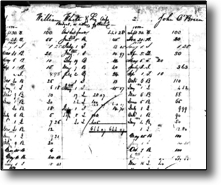 What a wondrous treasure trove of information! These records contain the deposit details for thousands of newly-arrived immigrants to New York from 1850. The bank was established by the Irish Emigrants Society and served a largely Irish population. Amazingly, the Emigrant Savings Bank is still around, holding about $15 billion in assets.
These older records are an immediate resource for genealogists. In addition to transaction details, the records include a ‘test book’ which contains information on place of residence, spouse and children, occupation, and additional other nuggets of information ((Check out the finding aid from the NYPL referenced above for more details)). This information was compiled when a depositor wished to send money back home to Ireland. I am particularly fascinated by the ledgers which record deposits and withdrawals for a large groups of people over a substantial period of time. There is a huge further digitisation project here to continue to enter data from these records into formats allowing for further study.
A few years back I read Tyler Anbinder’s Five Points: The Nineteenth-Century New York City Neighborhood That Invented Tap Dance, Stole Elections and Became the Worlds Most Notorious Slum. 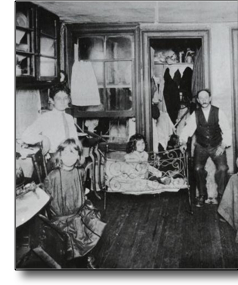 Great title eh? This one one of the most compelling microhistories that I have read and I was struck at the time by the references to individual savings. In this work, Anbinder challenges the appearances of abject poverty to note that many people in this area were living in squalour, but saving relatively enormous amounts of capital. He posits that this indicates that they were willing to sacrifice immediate luxury (or even decency) for an eventual opportunity to move outside of the five points neighbourhood. A fascinating finding. Five Points, is incidently the setting for Scorcese’s Gangs of New York and also for Jacob Riis’ late nineteenth century photo documentary of the urban social distress, How the Other Half Lives.
 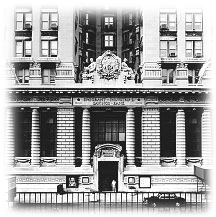 Now I have a sense where Anbinder was able to get some of his information from. He used this information skilfully to provide a fascinating insight on the individual priorities of immigrants. I only wish that I had access to similar banking records within the geography of my dissertation work. Dunn and Co. records provided some fascinating insights on local entrepreneurialism, but are disappointingly sparse and irregular.
Now that access expanded from the microfilm rolls at the New York Public Library, new eyes and questioning minds can appreciate this wealth of data and start to gain fresher understanding of a superficially bleak, but apparently hopeful time.