
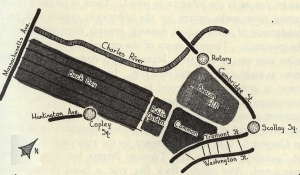
 One of the software engineers at Google Book Search has posted examples from his group’s experience in creating their own mashups. They created mashups from the places mentioned in particular books. As he states, he moved to New York and was in the gradual phase of getting his bearings and made a connection between what he was doing and where he was. Even more profoundly the mashups result from a connection between the context of the works being catalogued (ofter imaginary worlds, but nonetheless disembodied worlds) that have some reference to the real world in which he found himself. This in a pervasive realization and falls very much down the idea of traveling in history as well and the impetus for my own NapoleonicTourist concept. David Petrou was cycling to work past specific places which were noted in the works that he was indexing and by noting them on maps he made a concrete connection between the work and the real world and further is establishing his own sense of what his community means to him. To me this has far reaching consequences that build on Kevin Lynch’s work with mental mapping and communities to, in a sense, extend these through perception more known than seen aspects of your own neighbourhood. The ability to convey this added context has the potential to change the perception of visited locales as well by enhancing the experience and directly tapping into the way in which we perceive our immediate surrounding and augmenting this through this connection of place to context.
Check out the Travels of Marco Polo for a great example of a geographically broad application of their mashup technology.