

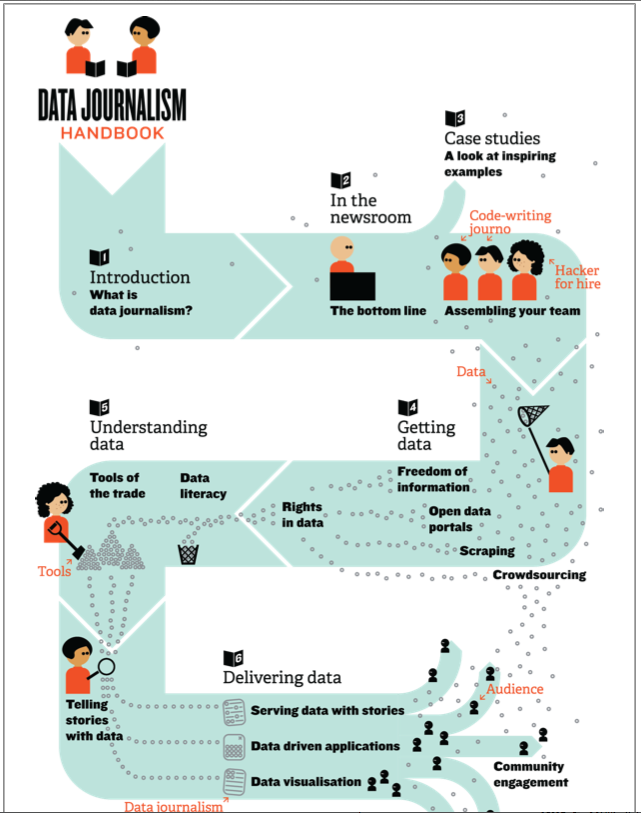
 The particularly well-conceived infographic that illustrates the story arc of this handbook started my relationship with the book on a very positive tone. The diagram provides a superb roadmap and gives me (as a self-perceived visual thinker) an indication of where I can derive the most value from it. It also describes the general intent of the book itself and I give it a very strong recommendation. According to the accompanying narrative it was conceived and initially constructed in a 48 hours session at MozFest 2011 and then refined online amongst a large group of contributors. The Data Journalism Handbook (an early release version is what I have been provided with and am reviewing) is aimed to “give you a sense of how to get started [with data journalism] and where to look if you want to go further. Examples and tutorials serve to be illustrative rather than exhaustive.” So why I am reading this? Natural inquisitiveness of course, but also to explore this concept of telling a story with numbers … or with other forms of data. Professional and personally it interests me – and I found this collected volume a treasure trove of real-world examples, pithy observations and real nuggets of emerging thought.
This instructional and thought-provoking book looks to the a rapidly emerging sector of the media engaged around presenting, interpreting and most innovatively developing and providing interactive tools for working with publicly available data – as part of a ‘new’ media initiative. It is not a ‘normally structured’ sort of book. In this I mean it is far less structured than most. It has a solid coherence around the general theme and if you take a look at the story arc infographic I mentioned above you will see that it does follow a determined path, but there is a less clearly narrative structure.
 To extract just one aspect that I found particularly supportive of the simple need for this sort of handbook is the statement that ‘Data journalism is about mass data literacy’. This looks to a larger cultural change that is taking place in the audience and the rapidity of this change. I have found the Guardian and the New York Times particularly notable in this and a reference to the Guardian’s data processing experience is one of the case studies explained as part of the ‘In the Newsroom’ section. The Guardian has been very forward thinking but also very open about how they have approached this data journalism revolution and absence of such discussion would have been almost unforgiveable in a book such as this – so they checked the box but more importably put it into a larger context of experiences from around the world.
The In the Newsroom section is largely case driven. The Getting Data section moves more towards an interrogative question and answer format. Understanding Data is probably the most didactic section of the book and has the strongest narrative. It combines some of the question/answer with a very solid process approach to data mingling and processing for journalistic use. Presenting and Delivering Data is the most speculative of the sections and explores ways in which this is being done today but poses many interesting ideas that are meant to inspire. All in all the variety of the sections keeps it very fresh and engaging.
This handbook is lavishly illustrated and well directed to URLs for further discussion. I found that the questions posed in the ongoing discussion were clearly identified and the entire handbook takes the form of this ongoing discussion rather than a direct narrative. I found that this worked for me and I tended to move back and forth through the handbook attracted to specific questions and consumed the book piecemeal. I expect most people will find this the most useful way to consume it. As it is an assemblage of contributions from a wide ranging group, the style of prose does tend to vary somewhat between sections, but I am struck that it lends a surprising freshness. Most importantly, this handbook is very comprehensive and current. As with any of these printed works in emerging fields the challenge will be to keep it current over time, but I have sense that this one in particular will age well due to its richly diverse sourcing and reflection.
Data Journalism truly extends beyond the realms of ‘journalism’ as it is traditionally defined. I would posit that as consumers of the new interactive presentations increasingly found in the new media, we are both consumers and also creators of our own journalism. Curators journalists that interact and create our own interpretations and tis is what interested me in the outset to take a look at this book. I found it a fascinating read, dealign with current matters, presenting engaging examples and generally testing an emerging field with critical attention. I would recommend it for a wide variety of audiences and principally for anyone who finds themselves immersed in this new interactive data-driven media world in which we find ourselves.