
randomosity

strikingly random thoughts and 'maximum data existentialisation'

  • Research
    • Conference Papers
    • Datasets
      • 1871 Populations of Ontario
      • Breweries and Distilleries in Ontario, 1914–15
      • Canadian Federal Railway Charters
      • 1871 Tavernkeepers in Huron County
    • Maps
      • 1891 Ontario Census Divisions
      • Admissions from Gaols to Hamilton Asylum
      • Asylums in New Zealand, 1900
      • Asylums in Scotland, 1797–1897
      • Asylums in the Australian Colonies, 1860
      • Asylums in Western Canada, 1911
      • Asylums of England and Wales, 1765–1845
      • Asylums of England and Wales, 1845–1860
      • Asylums of Ireland, 1814–1869
      • Discharge Rate from Hamilton Asylum
      • Duration of Stay for First Admissions to Hamilton Asylum
      • First Admissions to Hamilton Asylum by County
      • Rate of Readmission to Hamilton Asylum
      • Study Context
      • 1841 Settlers Map of Ontario
      • 1851 Essex County by Religion Stated in Census
      • 1848 Circulation Map of Paris
      • Modern Circulation Map of Paris
      • Irish and Indian-Trained Psychiatrists in Canada
      • Asylums in the United States, 1850
    • Other Research Stuff
      • Sir Frank Smith
    • Visual Support Materials
      • 1851 — 1911 Essex County Census District Evolution
      • Guelph Historical GIS
      • Occupational Comparison 1867–2007
      • Pajek Apple Taxonomy
      • Napoleonic Timeline
      • 1878 Guelph Mass Model
  • Gallery
  • Archives
  • About
    • Contact Me
    • Contact Me
    • Curriculum Vitae
    • Ligit Results
    • Movies
    • Stuff
    • Stats
    • Collophon
    • Delicious Tags

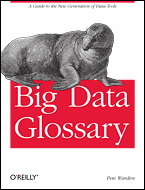
Big Data Glossary by Pete Warden

Posted by shawnday on 25 October 2011
Posted in: Info Architecture, Review. Tagged: O'Reilly, Review. Leave a Comment

bigData.gifThe *Big* Data Gloss­ary is actu­ally a rel­at­ively *short* book, best enjoyed as an eBook in my estim­a­tion. This volume is sim­ilar to a num­ber of recent releases from O’Reilly that have moved from being deep and com­pre­hens­ive to provid­ing a higher-level taste-test over­view from a more con­cep­tual stand­point. In this instance, the Big Data Gloss­ary by Pete Warden could also be described as an annot­ated bib­li­o­graphy of the vari­ety of tools and plat­forms recently emerged to work with linked data or large and rich datasets.

This gloss­ary moved through the basic ser­vices and com­pon­ents that could be employed to cre­ate a com­pre­hens­ive research envir­on­ment to con­duct data-mining or to cre­ate a deep visu­al­isa­tion for ana­lysis. The con­cise volume is designed to provide a con­text for fur­ther explor­a­tion of the vari­ous tools and ser­vices defined and offers use­ful links for such explor­a­tion. The anti­cip­ated audi­ence for this volume might be an aca­demic researcher new to the areas men­tioned or a developer trans­ition­ing from a more tra­di­tional data back­ground. Although brief the volume does much to draw together a qual­i­fied list of ser­vices and accom­plished much by identi­fy­ing the stronger cur­rent play­ers and sum­mar­iz­ing the strengths and weak­nesses of each. In this regard you might con­sider this book more of a tech­nical industry sur­vey. It is a valu­able wee tome for get­ting up to speed quickly with the play­ers and know­ing how you might judge ser­vices with in a par­tic­u­lar cat­egory as diverse as on-demand stor­age, data visu­al­isa­tion or nat­ural lan­guage pro­cessing. Much like Design­ing Data VIsu­al­isa­tions which I pre­vi­ously reviewed, this volume too could fit very nicely into an intro­duct­ory syl­labus and provide and excel­lent guide for an intro­duc­tion to data pro­cessing or digital research methodologies.

I have no cri­ti­cisms of this book. It’s short and con­cise and although you’d cer­tainly like more info, it does what it bills itself to do. And it does it well. It is the sort of book again that lends itself to an elec­tronic format as the con­tent by defin­i­tion is con­stantly chan­ging and evolving. If any­thing, the ways in which the vari­ous ser­vices are described tex­tu­ally prob­ably could be accom­plished in a tab­u­lar format which would facil­it­ate bet­ter cross-service eval­u­ation of fea­tures, strengths and weak­nesses, but that’s what wiki­pe­dia is for. The descrip­tions here are brief enough that you will read through at least a chapter as whole (if not the entire volume) and come away with an informed under­stand­ing of a par­tic­u­lar space.

I would recom­mend this book to any­one need­ing to quickly bring them­selves up to speed on the avail­able ser­vices in a spe­cific area of data pro­cessing, those wish­ing to keep cur­rent with emer­ging play­ers or those that are facing devel­op­ing require­ments doc­u­ments that may need to provide def­in­ite tech­no­lo­gical ref­er­ences (or for that mat­ter want to speak in real world terms about con­cep­tual solutions).

201110251411.jpg

Share this:

  • Print
  • LinkedIn
  • Twit­ter
  • Google +1
  • Tumblr

Posts navigation

← Designing Data Visulisations by Julie Steele and Noah Iliinsky
Ten Photo Assignments by Amanda Quintenz-Fiedler →
Logging In...
Cancel Reply
  • about.me

    Shawn Day

    Shawn Day

    Shawn Day is an entrepreneur, digital historian, economist and blender of the aesthetic and the informative. Raised in Canada, Shawn now works with the Digital Humanities Observatory, a project of the Royal Irish Academy, to leverage Ireland's participation in the emerging practise of digital humanities scholarship. He lectures in Social Computing and the Philosophy of Technology.

    His own research explores the social and economic circumstances of the nineteenth century retail liquor trade and it's impact on family. He applies digital, spatial and social network analysis to the study of the relationships between credit, respectability, and order in the Victorian community. Recent articles have examined the social dimensions of the Victorian public mental hospital using GIS and statistical modeling tools. Shawn has been involved in a number of successful and innovative digital humanities projects throughout Canada. Most recently he has worked with large manuscript census databases in the 1871/1891 census project (University of Guelph). He is a team member of the national TAPoR text analysis portal project, the Canadian Network for Economic History and the Network for Canadian History and the Environment (NiCHE - UWO).

    Shawn has blended his background in management economics with an entrepreneurial ethos to found a number of successful software development ventures in Canada and find a means to leverage this in the academic arena.

  • Twitter Updates

    • stallman reminds - Amazon recalls (and embodies) Orwell's '1984' news.cnet.com/8301-13860_3-1… via @CNET 21 hours ago
    • Well spotted - thoughtful: “@kcor1964: Why innovation is so hard to achieve management.fortune.cnn.com/2013/01/16/why…” 1 day ago
    • RT @adriansalmon: "There once was a curate from Kew Who kept a small cat in a pew. He taught it to speak Alphabetical Greek, But it neve ... 1 day ago
    • RT @rcahms: Telling Scotland's Story: download the new @ScARFHub booklet & uncover stories from the past bit.ly/VqaCWh 1 day ago
    • “@dtapscott: We don't need politicians in charge. With technology, it's time to put citizens first ow.ly/hmWi1” #eGov #Gov2.0 1 day ago
  • Flickr

    			shawnday posted a photo:				shawnday posted a photo:				shawnday posted a photo:				shawnday posted a photo:	this is a picture a trout that has been 'printed' from a three dimensional printer.			shawnday posted a photo:
    Used tag: geoffrey
  • Enter your email address to subscribe to this blog and receive notifications of new posts by email.

  • Pages

    • About
      • Collophon
      • Contact Me
      • Contact Me
      • Curriculum Vitae
      • Delicious Tags
      • Ligit Results
      • Movies
      • Stats
      • Stuff
    • Archives
    • Gallery
    • Research
      • Conference Papers
      • Datasets
        • 1871 Populations of Ontario
        • 1871 Tavernkeepers in Huron County
        • Breweries and Distilleries in Ontario, 1914–15
        • Canadian Federal Railway Charters
      • Maps
        • 1841 Settlers Map of Ontario
        • 1848 Circulation Map of Paris
        • 1851 Essex County by Religion Stated in Census
        • 1891 Ontario Census Divisions
        • Admissions from Gaols to Hamilton Asylum
        • Asylums in New Zealand, 1900
        • Asylums in Scotland, 1797–1897
        • Asylums in the Australian Colonies, 1860
        • Asylums in the United States, 1850
        • Asylums in Western Canada, 1911
        • Asylums of England and Wales, 1765–1845
        • Asylums of England and Wales, 1845–1860
        • Asylums of Ireland, 1814–1869
        • Discharge Rate from Hamilton Asylum
        • Duration of Stay for First Admissions to Hamilton Asylum
        • First Admissions to Hamilton Asylum by County
        • Irish and Indian-Trained Psychiatrists in Canada
        • Modern Circulation Map of Paris
        • Rate of Readmission to Hamilton Asylum
        • Study Context
      • Other Research Stuff
        • Sir Frank Smith
      • Visual Support Materials
        • 1851 — 1911 Essex County Census District Evolution
        • 1878 Guelph Mass Model
        • Guelph Historical GIS
        • Napoleonic Timeline
        • Occupational Comparison 1867–2007
        • Pajek Apple Taxonomy
Proudly powered by WordPress Theme: Parament by Automattic.