
randomosity

strikingly random thoughts and 'maximum data existentialisation'

  • Research
    • Conference Papers
    • Datasets
      • 1871 Populations of Ontario
      • Breweries and Distilleries in Ontario, 1914–15
      • Canadian Federal Railway Charters
      • 1871 Tavernkeepers in Huron County
    • Maps
      • 1891 Ontario Census Divisions
      • Admissions from Gaols to Hamilton Asylum
      • Asylums in New Zealand, 1900
      • Asylums in Scotland, 1797–1897
      • Asylums in the Australian Colonies, 1860
      • Asylums in Western Canada, 1911
      • Asylums of England and Wales, 1765–1845
      • Asylums of England and Wales, 1845–1860
      • Asylums of Ireland, 1814–1869
      • Discharge Rate from Hamilton Asylum
      • Duration of Stay for First Admissions to Hamilton Asylum
      • First Admissions to Hamilton Asylum by County
      • Rate of Readmission to Hamilton Asylum
      • Study Context
      • 1841 Settlers Map of Ontario
      • 1851 Essex County by Religion Stated in Census
      • 1848 Circulation Map of Paris
      • Modern Circulation Map of Paris
      • Irish and Indian-Trained Psychiatrists in Canada
      • Asylums in the United States, 1850
    • Other Research Stuff
      • Sir Frank Smith
    • Visual Support Materials
      • 1851 — 1911 Essex County Census District Evolution
      • Guelph Historical GIS
      • Occupational Comparison 1867–2007
      • Pajek Apple Taxonomy
      • Napoleonic Timeline
      • 1878 Guelph Mass Model
  • Gallery
  • Archives
  • About
    • Contact Me
    • Contact Me
    • Curriculum Vitae
    • Ligit Results
    • Movies
    • Stuff
    • Stats
    • Collophon
    • Delicious Tags

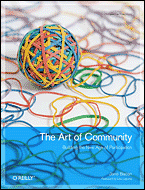
The Art of Community by Jono Bacon

Posted by shawnday on 7 January 2011
Posted in: Info Architecture, Marketing, Technology. Tagged: O'Reilly, Review. Leave a Comment

artofcommunity.gifIn The Art of Com­munity, Jono Bacon tackles the task of explain­ing how to attract, build and main­tain pro­duct­ive col­lab­or­at­ive online com­munit­ies. Bacon has had impress­ive cre­den­tials to author such a book and draws from his exper­i­ence skill­fully. With over ten years exper­i­ence in the open source com­munity he has the hands-on exper­i­ence with ini­ti­at­ives such as com­munity man­ager for Ubuntu, KDE and OpenAdvantage.

The book is organ­ised logic­ally with a healthy selec­tion of applied chapters in design­ing a strategy, under­stand­ing the soci­olo­gical aspects behind com­munity form­a­tion, through under­stand­ing com­munity health and deal­ing with issues that arise. Bacon freely admits that this is an abso­lutely fluid non-science in con­stant evol­u­tion and stays well to the prin­ciples couched in his own experience.

I like the lyr­ical style of the book. Bacon keeps the prose sur­pris­ingly light for the nature of the topic (i.e. he could eas­ily fall to using too much jar­gon to impact a sci­entific palour — he effect­ively avoids this). I like his con­stant inter­jec­tions from per­sonal exper­i­ence and informal lan­guage. Sec­tions are kept shorter and read­able and he has made an attempt to dis­till learn­ing into a series of spe­cific and focus points. Addi­tion­ally he car­ries a use­ful thread through his nar­rat­ive remind­ing the reader at reg­u­lar instances of what has been covered and where we should be at in the pro­cess of under­stand­ing. Not­with­stand­ing this he does not attempt to imply that there is a tried and proven pro­cess that will lead to suc­cess, instead sug­gest­ing that he is shar­ing one path of many. The defin­i­tion of this path is well illus­trated and logic­ally delin­eated. The basis is provided for each and thus allow for indi­vidual adjust­ment or judge­ment of whether it is applicable.

This book effect­ively com­bines the philo­soph­ical with the tech­nical spe­cif­ics. Although gen­er­ally aimed at the stra­tegic level in the chapter on ‘Sup­port­ing Work­flow with Tools’ for example, Bacon provides con­struct­ive and use­ful real world examples of hands-on use with spe­cific tools, and con­sist­ently ties these to the lar­ger prin­ciples of change man­age­ment pro­cess in light of the wider prin­ciples of assess­ment and response.

This a use­ful book not just for those dir­ectly charged with the the emer­ging task of com­munity man­ager, but also those that have the vis­ion to real­ise the import­ance of main­tain­ing com­munity whether they are on the fin­an­cial or mar­ket­ing side of the organisation.

I would fur­ther recom­mend this book as a less detailed read for those hop­ing to quickly grasp the import­ance of the task and the evol­u­tion of the mar­ket­place in the era of Enter­prise 2.0.

Also…check out the com­pan­ion web­site to the book.

I review for the O'Reilly Blogger Review Program


Share this:

  • Print
  • LinkedIn
  • Twit­ter
  • Google +1
  • Tumblr

Posts navigation

← Beautiful Data: Theory in Practice editted by Toby Segaran and Jeff Hammerbacher
Data Analysis with Open Source Tools →
Logging In...
Cancel Reply
  • about.me

    Shawn Day

    Shawn Day

    Shawn Day is an entrepreneur, digital historian, economist and blender of the aesthetic and the informative. Raised in Canada, Shawn now works with the Digital Humanities Observatory, a project of the Royal Irish Academy, to leverage Ireland's participation in the emerging practise of digital humanities scholarship. He lectures in Social Computing and the Philosophy of Technology.

    His own research explores the social and economic circumstances of the nineteenth century retail liquor trade and it's impact on family. He applies digital, spatial and social network analysis to the study of the relationships between credit, respectability, and order in the Victorian community. Recent articles have examined the social dimensions of the Victorian public mental hospital using GIS and statistical modeling tools. Shawn has been involved in a number of successful and innovative digital humanities projects throughout Canada. Most recently he has worked with large manuscript census databases in the 1871/1891 census project (University of Guelph). He is a team member of the national TAPoR text analysis portal project, the Canadian Network for Economic History and the Network for Canadian History and the Environment (NiCHE - UWO).

    Shawn has blended his background in management economics with an entrepreneurial ethos to found a number of successful software development ventures in Canada and find a means to leverage this in the academic arena.

  • Twitter Updates

    • Great! - The Scientific Method Of The Mind: What Sherlock Holmes can teach us abo...: youtu.be/JfZd2oLIIMw via @youtube 6 hours ago
    • Quick Survey of Time and Space DH Spheres: I am participating in a workshop at University College Cork as part o... bit.ly/WwnQRA 10 hours ago
    • RT @DiggingIntoData: And, we're back! Round 3 of the int'l Digging into Data Challenge launches today w/ TEN research sponsors http://t. ... 22 hours ago
    • stallman reminds - Amazon recalls (and embodies) Orwell's '1984' news.cnet.com/8301-13860_3-1… via @CNET 2 days ago
    • Well spotted - thoughtful: “@kcor1964: Why innovation is so hard to achieve management.fortune.cnn.com/2013/01/16/why…” 2 days ago
  • Flickr

    			shawnday posted a photo:				shawnday posted a photo:				shawnday posted a photo:				shawnday posted a photo:				shawnday posted a photo:
    Used tag: concordia
  • Enter your email address to subscribe to this blog and receive notifications of new posts by email.

  • Pages

    • About
      • Collophon
      • Contact Me
      • Contact Me
      • Curriculum Vitae
      • Delicious Tags
      • Ligit Results
      • Movies
      • Stats
      • Stuff
    • Archives
    • Gallery
    • Research
      • Conference Papers
      • Datasets
        • 1871 Populations of Ontario
        • 1871 Tavernkeepers in Huron County
        • Breweries and Distilleries in Ontario, 1914–15
        • Canadian Federal Railway Charters
      • Maps
        • 1841 Settlers Map of Ontario
        • 1848 Circulation Map of Paris
        • 1851 Essex County by Religion Stated in Census
        • 1891 Ontario Census Divisions
        • Admissions from Gaols to Hamilton Asylum
        • Asylums in New Zealand, 1900
        • Asylums in Scotland, 1797–1897
        • Asylums in the Australian Colonies, 1860
        • Asylums in the United States, 1850
        • Asylums in Western Canada, 1911
        • Asylums of England and Wales, 1765–1845
        • Asylums of England and Wales, 1845–1860
        • Asylums of Ireland, 1814–1869
        • Discharge Rate from Hamilton Asylum
        • Duration of Stay for First Admissions to Hamilton Asylum
        • First Admissions to Hamilton Asylum by County
        • Irish and Indian-Trained Psychiatrists in Canada
        • Modern Circulation Map of Paris
        • Rate of Readmission to Hamilton Asylum
        • Study Context
      • Other Research Stuff
        • Sir Frank Smith
      • Visual Support Materials
        • 1851 — 1911 Essex County Census District Evolution
        • 1878 Guelph Mass Model
        • Guelph Historical GIS
        • Napoleonic Timeline
        • Occupational Comparison 1867–2007
        • Pajek Apple Taxonomy
Proudly powered by WordPress Theme: Parament by Automattic.