

Perhaps there is an inner historian within me. The latest spate of reviews featuring the iPhone versus this challenger and that has me thinking that at the pace that we move today we don’t take enough time 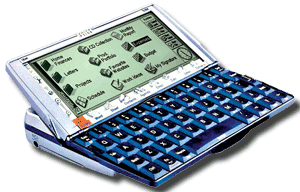 to reach a little further back to consider our forward progress. This case in point, everyone evaluating the iPhone or the iPod Touch (hereafter ITouch – as I am sure Apple would have rather called it) seems to be pitching it against the Nokia N95, HTC Kaiser, or the latest Blackberry. All appropriate for being the current flavour of the market – and when it comes to cell phones, they have such a limited shelf life. How long does the average phone remain current these days? Despite Apple’s slight revamp of the iPhone, I will go out on a limb and suggest that it may have greater longevity than most. However, not because for technical prowess, but to Apple’s marketing panache. Nonetheless, as I look at the comparisons, I am struck that we might best be able to gauge how much of a technical marvel it is by comparing a little further back.
The new AT&T Tilt (aka HTC Kaiser) reminded me in profile of my original Psion 5mx…and I got to thinking that a comparison between the the IPhone and a Newton is not really that far a stretch. My Newtons (culminating in the marvellous 2100) 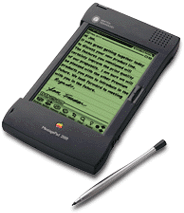 and the Psion are still wonderfully futuristic devices that got rather short shrifts. The Newton apparently for personal Jobs-Sculley reasons and the PSion because it was one of those funny little British things that just don’t get the mass exposure needed for viability.
As we ponder the effectiveness of the on screen virtual iPhone keyboard, one cannot be left unimpressed by the versatility of the technology. Technology that guesses what key you meant to press rather than actually pressed! Yet, for the great leap forward, I wonder why there isn’t a preference that allows you to match the keyboard to your finger size – or whether you are ‘typing’ with your fingers or operating the keyboard via your bug, clumsy thumbs. Mine have been too big and too clumsy every time I have tried the keyboard on the iTouch. While there were some technical flaws with the hinge mechanism on the Psion, that keyboard let one touch type on a tiny, yet powerful keyboard that folded into the device when not needed.
The Newton Keyboard was a little more cumbersome as it was a separate device, but it was a responsive little thing and allowed you the luxury of carry or not carrying.
The interaction with both these devices was surprisingly accommodating. You could be very screen driven very keyboard driven, or find your own combination of the two. With newer entrants I have found that you don’t have nearly the options of finding your best way of interacting with the device. You could hack the OS to your heart’s content and the manufacturer’s worked closely with third parties to develop an array of peripherals and software packages to meet diverse users’ needs.
One of the great pluses of the original Palm Pilot (name very deliberately used) was that it only let you interact in one way – but that one way was simple and solid. You either adapted to the Pilot or you didn’t. I remember experimenting with a paper based version (much in the same way it is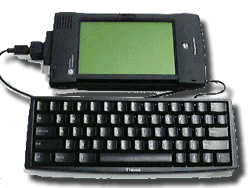 legendized that Jeff Hawkins did with a wood block) to see if it would work for me. The reward from this limitation of interaction was an instant-on, speedy address book with calendar. Overtime, the beauty of this simple approach was lost, but there was initial value in the tradeoff of speed for flexibility. Without sounding like the old codger remembering how things were done in his day, I wonder why it is as we have all the processing power of the iPhone running OSX that it isn’t just a wee bit more accommodating of our individual peculiarities. Is it the hubris that smacks of omniscient engineers that will teach us how we should use their devices?
How does an iPhone compare to a Newton or a Psion? I would suggest that there are areas in which the older devices demonstrate that trade offs have been made over time that have taken us down a different road. However, rather than pausing as we proceed down that road, and glance back to ensure that it was the right fork, we have moved along with little regard to where we came from. It like the marathon runners in a clump, taking a certain fork and continuing along, only glancing to their competition to the side to determine that they have taken the right route and assuming that since everyone else is on that path, then it must be the right and therefore best one.
This is all highly subjective of course. As my eye continue to fail, I am increasingly conscious of contrast and screen legibility. So, I come to be appreciative of the wonderfully backlit Newton or Psion (the Newton has served as a flashlight for me a couple times – you can light the room with that wonderful green glow). The screen on the Newton was phenomenal by the 2100 iteration. Unfortunately by the time it reached this pinnacle, it had also become tagged with ridicule for the poor initial performance of the text recognition engine. The history of computing is strewn with those that have rushed to market with underpowered devices to to gain the first mover advantage, only to succumb to harsh reviews that stall its subsequent momentum. Its obviously a close run thing. The 128K Macintosh in 1984 was severely handicapped and it was only through some fancy footwork with the Fat Mac and the subsequent Mac Plus that momentum was both sustained and eventually augmented.
The OS of the Psion was similarly impressive. Now it has evolved in to the Symbian OS of the Nokia phone and possibly been the inspiration for the Nokia Communicator series. The close-run thing is the thing – forgive the repetition. In so many cases, screen brightness is sacrificed for battery life, and we gain in small increments. And in the next iteration we inch a little further in the same direction, often seemingly without regard for the decision that took us down that direction of compromise in the first place.
Lenovo has made an interesting acknowledgment, if only semi-publicly. They had a winner in some of the early ThinkPad X series laptops. To my mind IBM reached a very solid plateau with the X32 and the length of time that this model sat on the price list was testament to the market’s affirmation of this. They reduced size and weight while simultaneously retaining processing power and the on-board graphics capability. Then they took a step too far. They decided that it was the small size and weight that was the crucial component in the balance and they sacrificed machine performance for another pound. The X4X series was a misstep. Small yes, but at too high a performance cost. They admitted there error and let the size of the newer X6X series creep back up and in exchange gave back some of the processing power and hard drive speed that had been lost. They caught their error, admitted their mistake and rectified it. They appear to be monitoring the balance and responding to missteps…a great little business school case.
There is no doubt that in the vision of the iPhone or the N95, one can glimpse the future of mobile computing and as we refine the notion of convergence between our mobile devices, these platforms give us room to grow, but I wonder how often those ever so crafty engineers look a little further back to see the future of mobile computing.
Excellent post! It was a beastly thing for the Newton and if true, the pettiness was sad. However, if Sculley fired my ass, and I had a chance to do him one in the eye, damn straight I cancel the Newton. The Newton is / was a great device, just a little to ahead of its time. If wireless had been much more prevalent in the 90’s, if at all, Bob’s yer uncle & Molly’s yer Aunt, the Newton is King!
Vale!