

I was finally was able to see Elizabeth: The Golden Age today and was not disappointed. This a movie worth seeing at the theatre.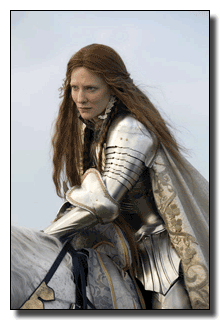 The settings are sumptuous, superbly shot and Cate Blanchett seems to be able to do no wrong. She is Elizabeth.
I am staying away from historical commentary here. This is a story for the screen and I appreciate it as such. However, I will say that I enjoyed the first installment ten years ago more. The two installments shared the lavish settings that set Shekhar Kapur apart, but the web of intrigue in the first was much more taut and tense. In the second installment, there is far less tension. Where tension exists, it seems weary or puerile. Relationships that may have been mined and explored such as that between Elizabeth and her cousin Mary Stuart are left docile and tepid. Mary, who I expected to speak with at least a French accent is unimposing and a mere dupe (certainly a faint shadow of Fanny Ardant’s Marie de Guise in the first). Although this fits in well with her role vis-a-vis Philip of Spain’s intrigue, this political and fratricidal battle between ‘princes who are female’ could have been mined and illuminated the ongoing struggle between free-thinkers and Roman Catholics. Kapur’s Mary is a stupid, unthreatening victim, and this doesn’t work well – far too simple. The same seems to be true with Philip himself. While we is portrayed in a commanding kingly way in the first, here he is much truer to life as a mildly deformed, unifocular grandee bent on world domination. This is not bad. However, the introduction of his young daughter is distracting. Her story and introduction do not seem to lend to the story at hand and seems disjointed. Are we to sense that Philip is simply trying to provide for her inheritance? – eg. “How would you like to be Queen of England?”
We all know that the Armada will come and there is little or no build-up to this point in the film and takes far too long to appear. When watching I grew rather frustrated waiting for the eventuality and sensing that a silly love story was getting in the way – a story far too detailed and without a sweeping grandeur. The armada battle sequences are generally well shot and delivered, but the sense of scale is lost with this story being such a brief foray. The tension that we lack elsewhere could have been very skillfully built here. In general, scenes are superbly composed and shot well and we have some of those wonderful shots from far above, reducing individuals to a smaller scale and establishing that larger forces are at work. We also have more shots from below (the swimming horse was intriguingly original), and his use of light is amazing. Elizabeth in her white grandeur at the end is spectacular.
On the other hand, Kapur seems to have grown fond of ‘keyhole’ type shots in this version, and I am not sure they work. Is there an unseen watcher? What is the importance of these vantage points? We peer through gaps in the stonework and windows cells that seem to distract from rather than lend to the visual effect.
Nonetheless, this is a crucial part of the story that Kapur has chosen to tell and it is a good story. As always, Blanchett is superb. She is able to catch the tremendous vulnerability, tempestuous wrath, and supreme power that Elizabeth was. The character has been substantially elabourated and the relationship with Walsingham similarly expanded. Rush is of course also strong in his role and we get to see some signs of his weakness as well, possibly missing from the earlier exploration.
I was also looking forward to Elizabeth’s speech on the battlefield and Kapur handles it well. This was a pivotal moment for Britain and Elizabeth delivers a superb exhortation to her troops to defend England or die trying. But I am left without a sense of panic or of ruthless determination on the part of the assembled militias. How were they feeling? Were they actually inspired? Their faces are blank. I think I will be forever spoiled by Brannagh’s delivery in Henry V. How to live up to that. Blanchett comes close.
My favourite scene is the stolen kiss with Raleigh. It captures much of the essence of the monarch trapped in her role, but yearning to escape. The lighting, the timing, the music, and the restricted moment is handled with tremendous ability. The role of Bess is also well handled, and it’s tough to live in the glow of Elizabeth. But we feel for her chief lady-in-waiting and the closest thing to a friend. She is unsayingly charged to live for Elizabeth, to serve her, but seek the experience she cannot have. She succeeds and acts as she feels she must restricted by her loyalty, but also a mere mortal.
As with all, I expect that much material ended up on the cutting room floor and look forward to a director’s cut to truly appreciate Kapur’s vision. The changing colour and tone as the movie progresses are subtle but impressive.
Clive Owen is well cast as Raleigh, as is Drake, although I sense that a balance between the two might have been established. And where are Elizabeth’s other advisers? Where we had a much more vulnerable young woman in a man’s world, outside of Walsingham, Raleigh, and Dee (a superb addition) we find faceless, pointless drones. Mary’s jailer has the security sense of a vegetable strainer and everyone seems to stand around waiting for something to happen. I sense again that this was in the cause of simplification and this is an unfortunate choice.
All in all, this story lacks some of the complexity of the first. It is as if it was dumbed down and the private life is overemphasized to the determent of seeing Elizabeth as monarch and embodiment of the nation. I am sure there is some intention in this if only simply to reinforce that she is a mortal, thrust into a role that she is not prepared to adopt. She finds strength from various sources and does rise to the occasion, but not before having her resolve tested.
I don’t want to in any way lead you to believe that I wasn’t entirely thrilled with the production. I point to the shortcomings because I have set this director and his ability on a very high pedestal. I haven’t been drawn to the theatre in a year. This is a movie that attracted and left me feeling very satisfied. Its largely perfectly cast, the determination to explore Elizabeth’s character successfully and a visual treat. I look forward to the director’s cut and would heartily recommend this most excellent movie to anyone heading for the theatre.