

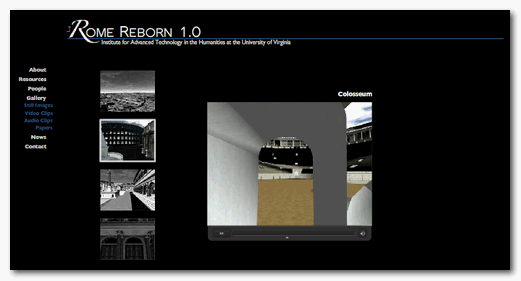
 Those clever folks at the IATH at the University of Virginia are receiving much deserved accolades for their truly breathtaking digital model of ancient Rome. Rome Reborn 1.0 (and accompanying website) are visually stunning and the mainstream media are covering this with great detail. Billed as the largest digital model of an historic city ever undertaken, it provides researchers with the opportunity to virtually walk the streets in real time and in many cases wander inside and look around. The model was constructed by hand and then digitized over the past decade. This is a massive undertaking and what, aside for the scale of the undertaking, makes this of great import is the attention to making this a fluid work in progress. Bernie Frischer’s speech, over ten years ago, introducing the project envisioned this fluidity and it is tribute to those involved that the goals have been preserved over the span of this enormous project. It has milestones, but does not have an endpoint. The project, like the digital model, is fluid. It reflects current appreciation and understanding, but will organically evolve as new information is introduced.
The creators of the project have just released the first digital fly-throughs of Rome Reborn as part of the unveiling. They have yet to determine how to make the model itself publicly ‘browsable.’ We are just scratching the surface in this exciting new field of visualisation. New uses for these tools are just being proposed and attempted. My own small experiments in constructing small scale 3D virtual streetscapes as an interface to exploring the lives of those that walked those streets are one tiny little aspect of this sphere of research. I use a rich spatial representation as a front end to manuscript census records and tax rolls. With Rome Reborn, inanimate objects push our technological capabilities. My appetite is whetted for the time that we can start remove the static temporal aspects that constrain these digital models to spatial representation, and begin to allow for the temporal exploration across time, not just a slice in time.
I have to say that after viewing the site in three browsers, the text on the site is abnormally tiny…just barely visible. As many of the IATH project they do love to use Flash to mediate the users interaction with their data. I have been accused of choosing too small a point size, but this is smaller by half again. However, the project is just so interesting that I persisted in squinting to read about it.
I love terms like ‘optimized the city model to run in real time.’ How digitally godlike can one presume to be? Too cool. Immediate perceptions of the project lead me to consider that next challenges for the immersive experience will be to for additional sensory aspects, such as audio to be added to the model. There was an interesting posting on H-Urban yesterday about just this facet – the concept of digitally modelling the sounds of a 19thC city. I sense that the baroque symphonic melodies that accompany the fly-throughs may not quite be temporally accurate 😉 I am also struck by the lack of Roman inhabitants. Frischer noted in 1996 that they did not want to create a ghost town, but I can’t see people anywhere and despite the magnificent architecture I am quite interested in the Romans themselves as well as the products of their endeavours; I want to appreciate the works of Biondo and the exploration of the runnings of ancient Rome.These little criticisms don’t distract from the enormous achievement that this model represents, and it is tribute to its success that it sparks the creativity in others to add to it and build upon such an accomplishment. It’s great because you get it and you want more.
Additionally:
-
Digital Forum
The reconstruction of the Roman Forum is an example of the smaller microprojects that Rome Reborn seeks to draw together as part of the larger reconstruction. This a very comprehensive site. I like the camera viewpoints in the timemap that combine the reconstruction with a modern view of the remains. The VR lets you adjust your view in either timeplane and see the results.
[…] that anyone playing in this arena inevitably faces. Projects such as Rome Reborn1.0 (which I blogged on earlier this year) have focussed on similar aesthetic recreation of the visual. One of the future directions for Rome […]