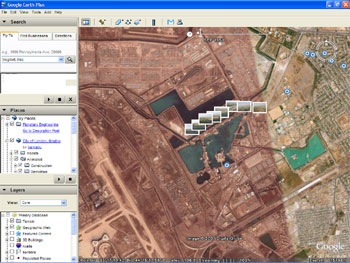
 There have been a wide swath of recent headlines connecting the success of insurgent activity in Iraq with their ability to acquire precise targeting data from Google Earth. Apparently searches of suspected locales in Iraq have turned up detailed satellite imagery of American or government installations acquired freely over the internet. Not too hard to believe. Its there. Some of the more right wing commentators have been demanding that Google think long and hard about the moral implications of its mission to encourage the wide and free dissemination of such information. This raises a huge censorship issue, one that seems not to trouble many in a ‘country under attack’ – that of course is the US, not Iraq. Paul McNamarra has an interesting blog entry in which he supports freedom of access, but suggests that Google has already censored information for much less spurious notions, i.e. Eric Schmidt feeling that his private life was being unfairly examined and cutting Google access off for CNET reporters.
So I popped over to tour Baghdad in Google Earthy myself. While its pretty simple to find military installations and most of the city is covered in superb detail, I was struck more by the additional imagery that has been provided through geotagging. There’s a wealth of visual imagery uploaded by private individuals naming camps and providing possibly even more up-to-date information. Hopefully this renders moot discussion of having high-level committees to decide what should be shown on Google Earth and what shouldn’t. This is an interesting hot potato. I wonder what the state of censorship is of blogs and emails? How does the US military try to keep up with the vast number of ways that sensitive information can be disseminated today?